
When people invest money, they often look at what happened in the past even though what matters most is what will happen in the future. Recent economic reports, which tell us about things that already happened, have made some investors and government officials worry about the economy. Some people are wondering if we might have a recession, which is when the economy shrinks and many people lose their jobs. Right now, we’re seeing mixed signals: the job market is slowing down and prices are still rising (called inflation), but unemployment is still low and the overall economy is still growing. For people who invest for the long term, these mixed signals make it very important to keep a balanced view.
Looking at economic information is hard, and understanding what affects markets is never simple. During times like these, it helps to focus less on news headlines and more on the basic parts of the economy. Often, the best place to start is by looking at how consumers (regular people who buy things) are doing financially. This is because consumer spending makes up more than two-thirds of all economic activity and directly affects how much money companies make.
So how are consumers doing in today’s complicated economic situation?
The job market has gotten weaker in recent months
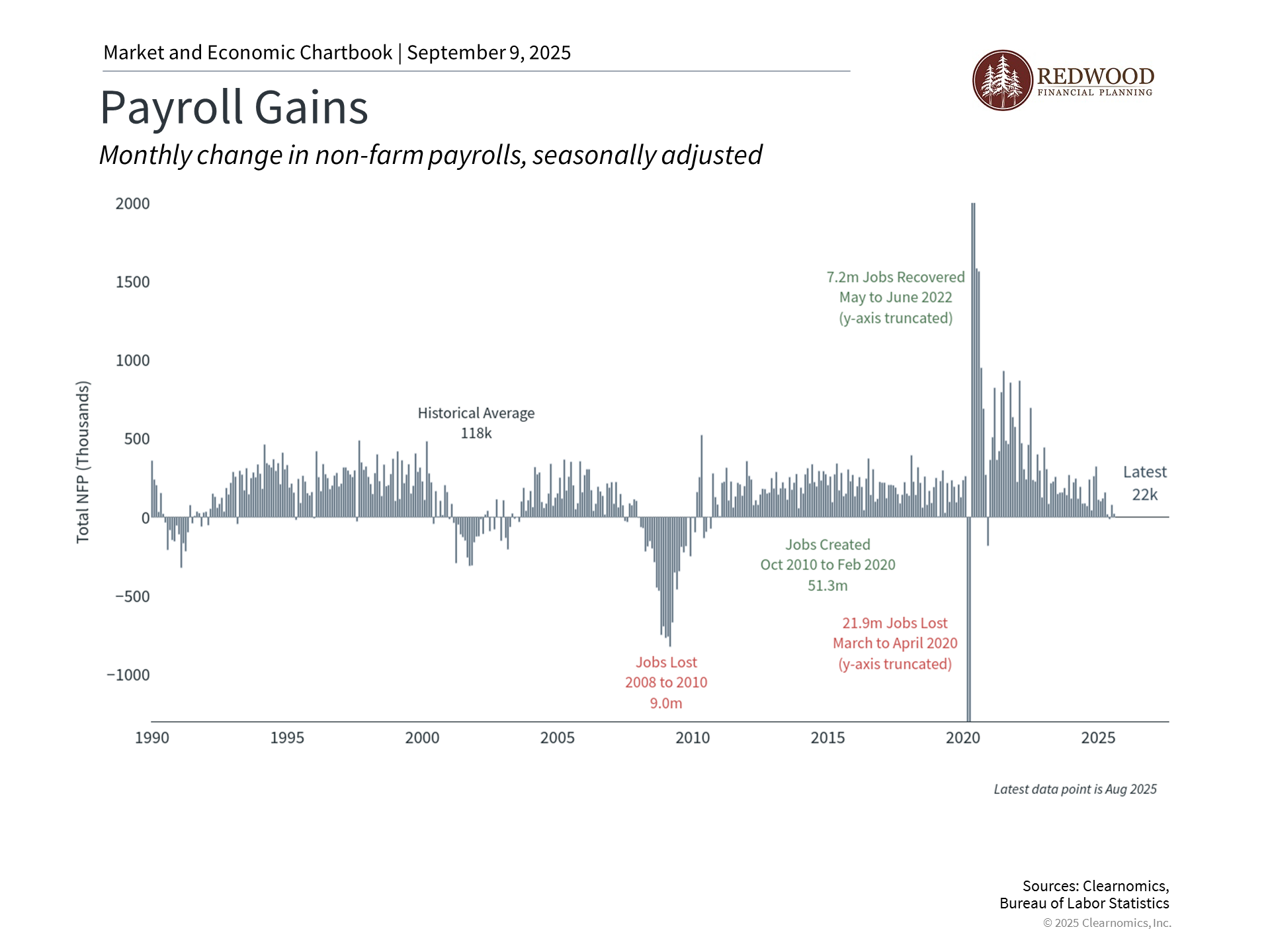
To understand how consumers are doing financially, it helps to look at the job market. The most recent jobs report gave us more proof that the job market is slowing down more than people expected. According to the Bureau of Labor Statistics (the government agency that tracks jobs), only 22,000 jobs were added in August. This was much lower than the 75,000 that economists thought would be added. The report also changed the numbers from earlier months, showing that the economy actually lost 13,000 jobs in June. This was the first time jobs decreased since 2020.
While these numbers are important and have been talked about a lot in financial news, economists don’t just look at the main job numbers, which can go up and down from month to month. Instead, they look at trends and consider something called “labor market slack.” This simply measures whether people who are looking for work can find jobs.
Fed Chair Jerome Powell (the head of the Federal Reserve, which is like the country’s main bank) recently said the current job market is in “a curious kind of balance” because both the number of workers available and the demand for workers have slowed down.1
The good news is that the unemployment rate (the percentage of people who want jobs but can’t find them) is only 4.3%. This is a positive sign that most people who want to work are able to find jobs. The “under-employment” rate, which includes workers who have given up looking for work, is also still very low at 8.1%. Other reports show there is still about one job opening for each unemployed person across the country. While this doesn’t mean everyone will find a job, it shows that companies are still hiring.
This matters because, when we look at both the job numbers and unemployment rates together, it suggests the job market is cooling down slowly rather than falling apart quickly. The important difference is that big jumps in unemployment have usually only happened because of major economic shocks, like the 2008 financial crisis or the 2020 pandemic. The current situation seems to show natural changes in the economy. For the Fed, this employment trend makes it more likely they will cut interest rates starting in September.
Consumer finances show strength despite some challenges
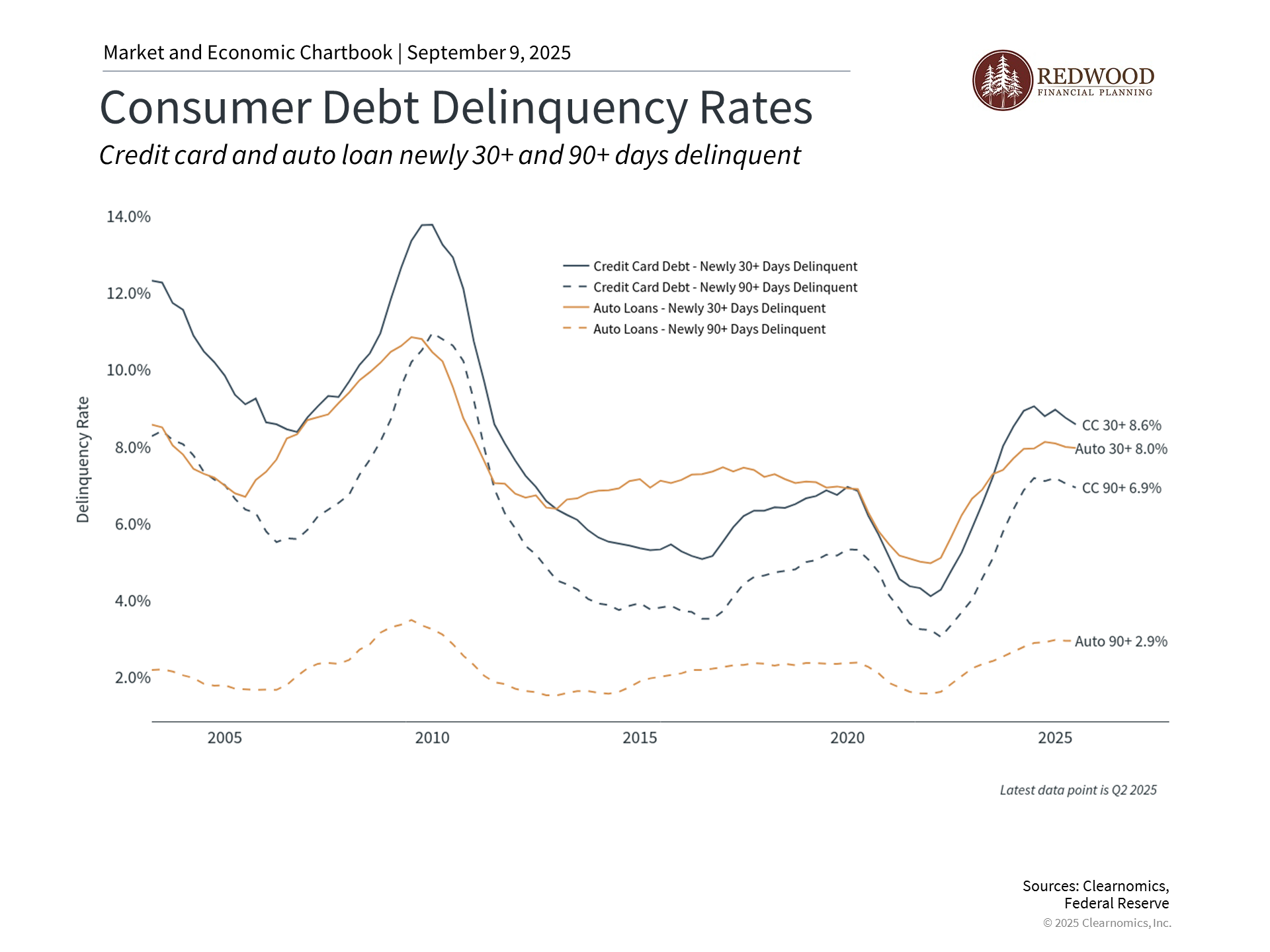
While the job market is getting softer, consumer finances overall are showing signs of a “two-speed economy.” This means people’s financial situations are different based on things like how much money and wealth they have. Many investors have focused on these numbers because the total amount of debt keeps rising across credit cards, car loans, student loans, and more. When households borrow too much money, it can be a problem if the economy gets worse. This was one of the factors that helped cause the financial crisis in 2008.
One way to understand if there are problems in household finances is to see whether people are paying their bills on time. The chart above shows that credit card and car loan delinquencies (when people can’t make their payments) have increased over the past two years. This is partly because consumers have borrowed more money and, more recently, because interest rates are higher. This rise in late payments has mainly happened among borrowers with lower credit scores, which gives us more proof of a two-speed economy.
However, the chart also shows that these late payment rates have leveled off recently and are still much lower than what we saw before 2008. And while the total amount of debt is high across the country, the amount that households are paying on their debt has stayed flat in recent months. This suggests that while some households may be feeling more pressure as they pay interest and principal (the original amount borrowed) on their loans, these numbers are not yet at levels that have typically led to recessions.
Household net worth stays near record high levels
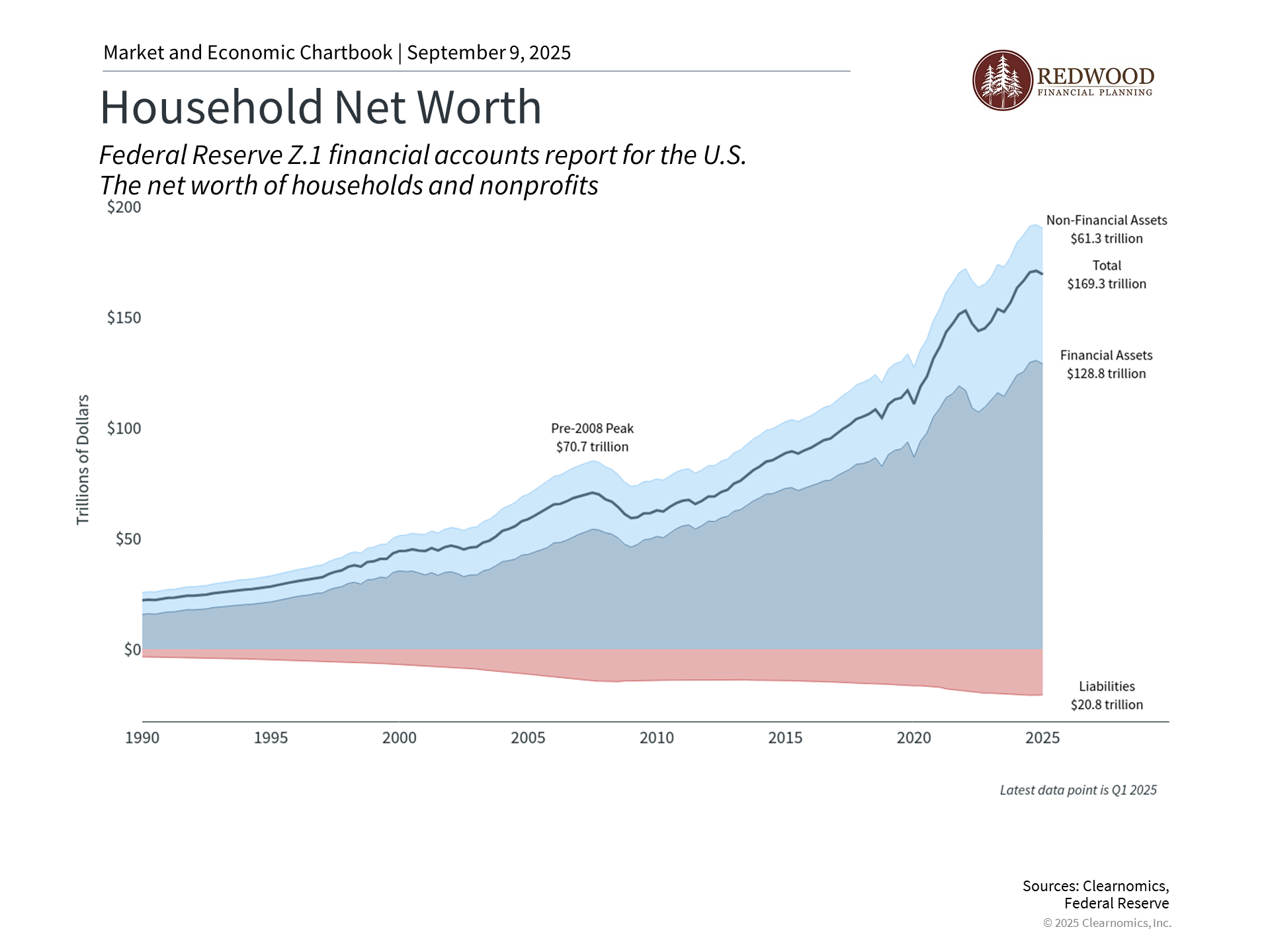
It’s easy to focus only on the debt side of consumers’ finances, since this is often where problems start. However, the asset side (what people own) is just as important, and U.S. household net worth (assets minus debts) is still near record levels today. This is shown in the chart above.
At $169 trillion, net worth has increased over the past 15 years because of steady economic growth, rising home prices, and strong stock market returns. Again, this shows a two-speed economy since the households that have borrowed more money in recent years may not be the same households that are benefiting from rising asset prices. Still, this wealth effect, where rising asset values help support consumer spending, can help provide economic stability. This is one reason why many of the concerns over the past few years haven’t always directly led to a weaker economy.
This also reminds us of what creates wealth over time, and why it’s important to have a portfolio (collection of investments) that fits your financial goals. During this period, there were many times when investors worried about recessions. While markets can react to bad news or experience drops in the short term, they often “climb the wall of worry” in the long term. For patient investors, focusing on where the long-term economy is headed is much more important than worrying about where it’s been.
The bottom line
While the job market has slowed down, making it more likely that the Fed will cut interest rates starting in September, it is only one part of the overall economic picture. When the future is uncertain, investors should focus on the underlying economic trends to keep their portfolios balanced.
1. https://www.federalreserve.gov/newsevents/speech/powell20250822a.htm

