
The stock market has swung in both directions in the days following the midterm election, driven primarily by technology and AI-related stocks. For financial markets, perhaps the most closely watched issue is the outlook for data center construction.
This is because the buildout of data centers has been a significant driver of economic activity and corporate profits as companies set up the infrastructure needed for AI applications. The midterm election results and related ballot measures suggest that voters are in favor of restricting this construction across all levels of government.
These developments add to pressures on technology stocks, which have contributed to portfolio returns in recent years but are also facing questions about valuations, interest rates, and whether large AI infrastructure buildouts will pay off. At the same time, volatility in these parts of the market is normal, and returns have been strong over longer time horizons.
What do the latest election results mean for markets, and how can investors maintain a broader perspective?
Voters largely sought to restrict data centers
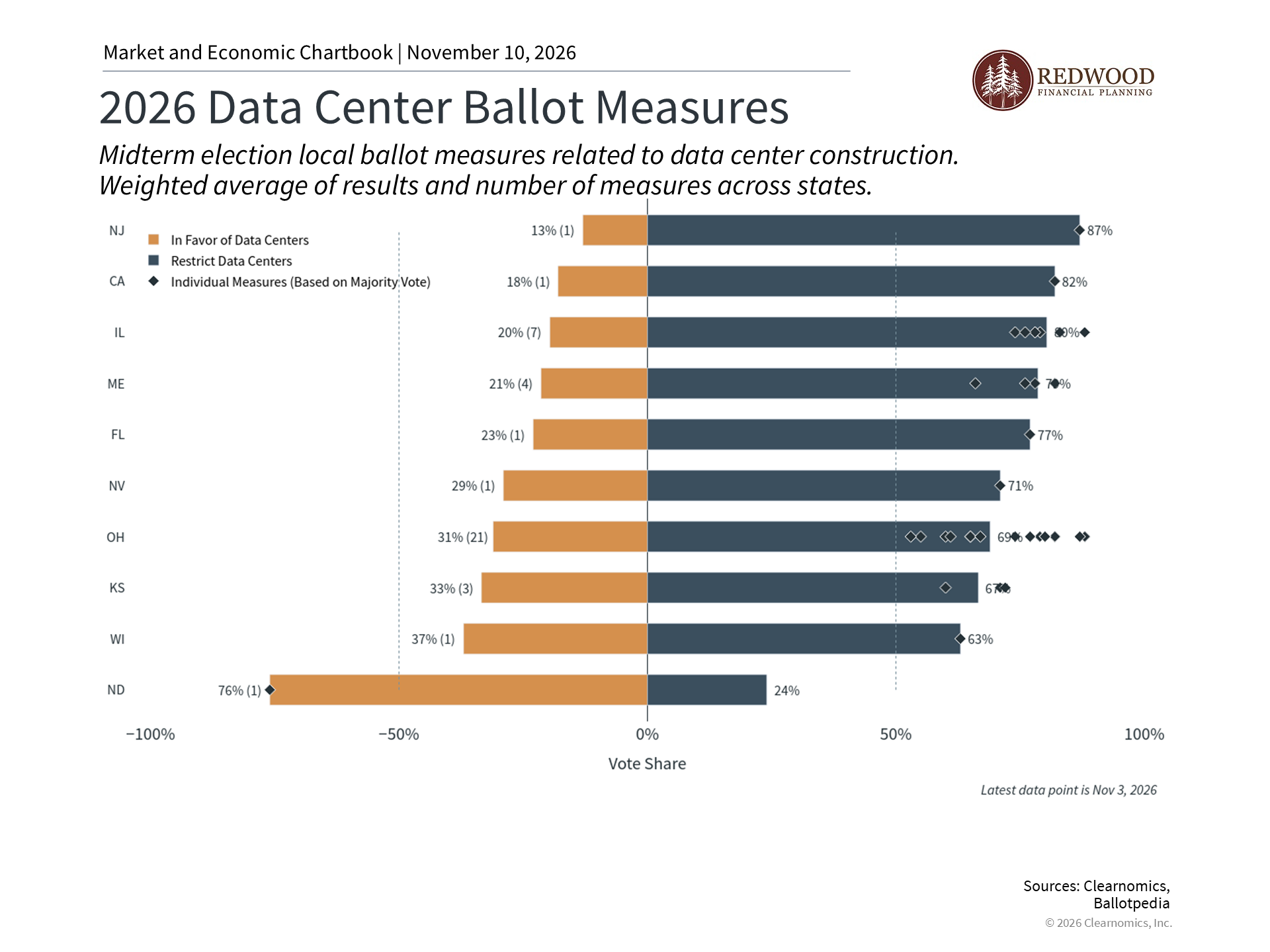
As the accompanying chart shows, voter opposition to data center construction was widespread. So far this year, there have been 47 local measures directly related to data centers, with 41 voted on during the midterm election across ten states.1 The ballot results so far show that voters support restrictions on data center construction by wide margins, with only one exception.
These measures varied in scope, covering zoning, electricity and water usage, and rules specific to data centers. For example, one measure in Kansas banned “high-impact” data centers, defined as facilities using more than 10 megawatts of electricity or 100,000 gallons of water per day, for 10 years. Towns in New Hampshire and Maine approved temporary moratoriums on new construction.
The one exception in the latest election was Harwood, North Dakota, a town of roughly 850 people, where about three-quarters of voters rejected stricter review requirements on large industrial projects. The result clears the way for construction to continue on a $3 billion data center campus. The reported reason was that a data center would likely have been built nearby regardless of how they voted. By allowing it within town limits, the community could capture tax revenues and other economic benefits.
The tension between the construction of infrastructure and the needs and desires of local communities is not new, but is accelerating due to the rapidly growing demands of AI applications.
Historical parallels include the construction of oil and gas drilling sites, which many communities have long considered by weighing environmental and quality-of-life concerns against jobs and tax revenues. The same “Not In My Backyard” (NIMBY) dynamic also occurs with highways, power plants, cell phone towers, and more. Data centers are the latest example of a large industrial buildout affecting residential communities, raising concerns about power usage, water consumption, and the scale of these facilities.
Another parallel is the construction of large job-creating factories, which many towns and cities historically fought to obtain. An extreme version of this was the industrial towns of the 19th and 20th centuries, where manufacturing plants, mills, and production lines were not just central to local economies, but had towns that were built around them. In many cases, these facilities brought economic benefits to their communities, including jobs, tax revenues, and local investment. In hindsight, these towns had a mixed track record, and history shows that a high dependence on a single economic engine can create challenges, in addition to issues such as environmental concerns, noise, and strain on local infrastructure.
Data centers are following a similar pattern with the key difference being that they are typically capital intensive, meaning they require lots of investment and equipment, but are not necessarily labor intensive. The fact that data centers are not necessarily a significant long-term source of jobs for local communities appears to be an important reason for the pushback that ballot results have shown.
Data center construction has supported the economy
Why have data centers become such a central focus?
First, it’s helpful to understand what they are. When we visit a website or app, use a search engine, send an e-mail, buy something online, or chat with an AI model, these requests are handled by servers. A data center is essentially a very large warehouse packed from floor to ceiling with servers, and can span anywhere from a few dozen to 1,000 acres. The servers run around the clock, requiring electricity, cooling, security, and more. This forms the physical infrastructure that supports all digital services, which is increasingly dominated by AI use.
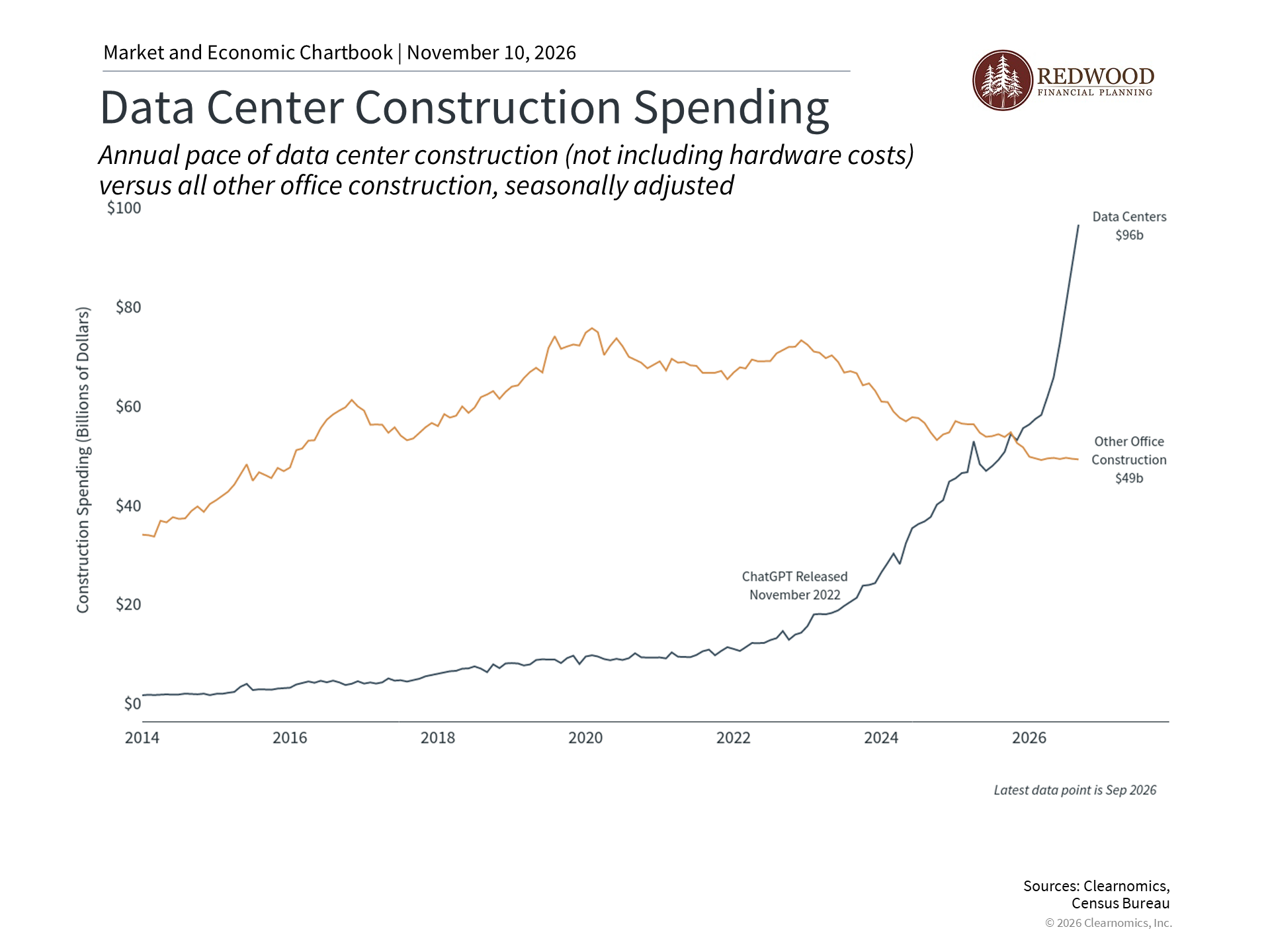
Spending on these facilities has grown in terms of its contribution to economic activity. As the chart above shows, data center construction spending, not including the hardware inside, has risen sharply since the launch of ChatGPT in late 2022. The Census Bureau estimates it has risen to $96 billion on an annualized basis, well above the roughly $49 billion spent on all other office construction.2 This buildout is one reason the gross private domestic investment component of Gross Domestic Product (GDP), which measures business spending on structures, equipment, and more, accelerated to 3.3% in the third quarter, according to the Bureau of Economic Analysis.3
It’s important to distinguish between the potential long-term benefit of AI that many are hoping for, such as productivity gains, improved profit margins, and new business models, from what is currently driving AI trends. Today, it’s the physical construction of infrastructure that has been propelling economic activity and financial markets when it comes to AI.
This is similar to the railroad boom of the 19th century, where laying rail lines created jobs and demand for steel and other materials. However, this was separate from the longer-term gains that faster transportation eventually delivered to the entire economy. Restrictions on data centers may affect the pace of construction activity, but whether AI applications truly do boost productivity and provide real economic benefits is what will determine the longer-term trajectory of AI adoption.
Technology and AI stocks can be volatile
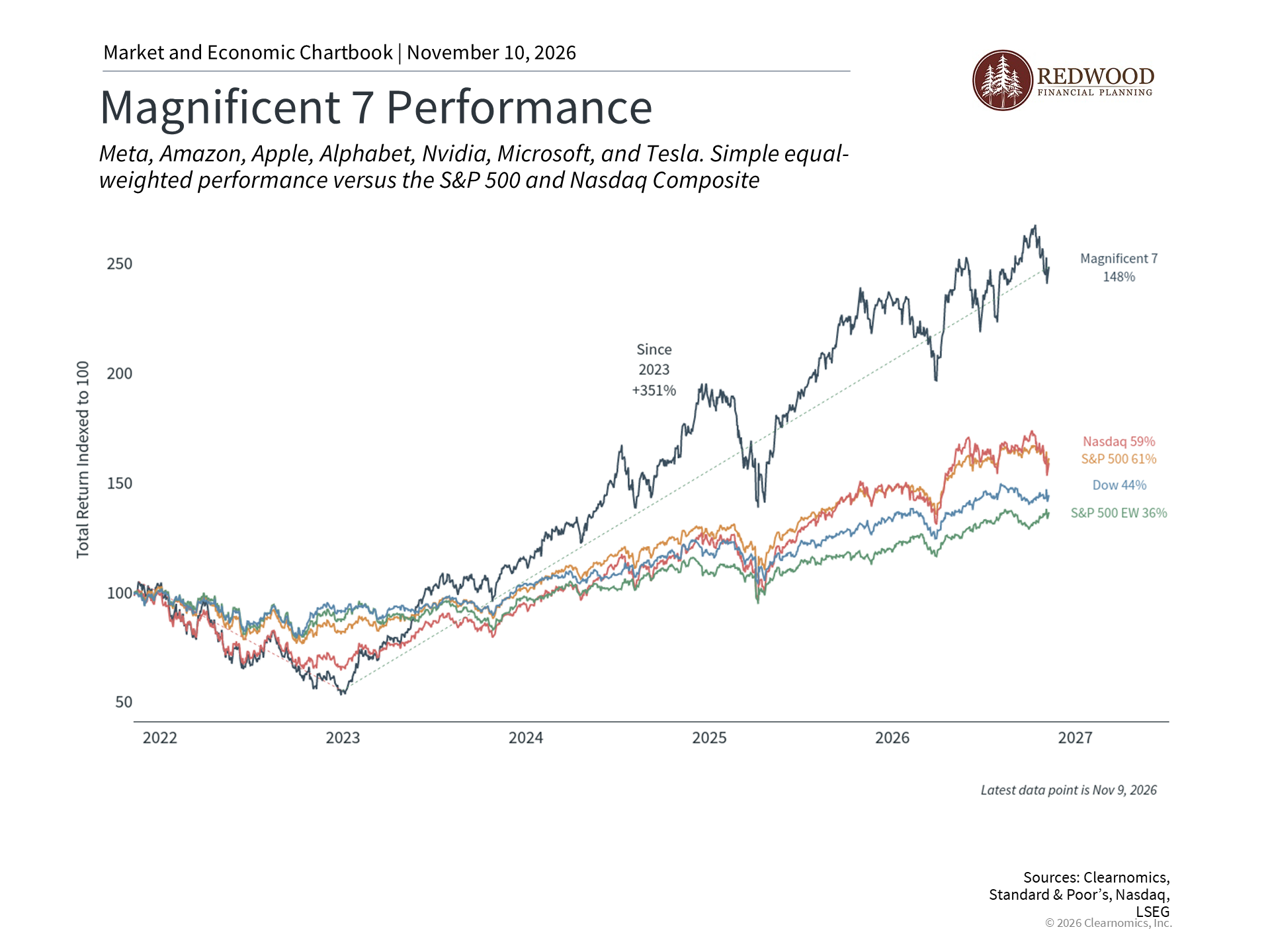
As the chart illustrates, the Magnificent 7 group of technology stocks, which includes Meta, Amazon, Apple, Alphabet, Nvidia, Microsoft, and Tesla, has generated strong returns over the past several years. These stocks have gained around 140% since 2022 and rose about 340% from the start of 2023 to their recent peak, outpacing both the S&P 500 and the Nasdaq.4 However, the chart also shows large pullbacks along the way, including the current period of volatility.
The market’s reaction has not been the same across all AI-related companies. Semiconductor makers and so-called “neoclouds,” which are new public companies that provide cloud computing services, experienced sharper declines in the days following the election. In contrast, large “hyperscalers,” the companies that are funding the AI buildout, did not see their share prices pull back as much, although they have been under stress due to concerns over their cash flows.
Pullbacks like these are not unusual, even for companies with strong long-term fundamentals. In 2022, when interest rates rose rapidly, the Magnificent 7 declined by nearly 50% before recovering and generating healthy returns for long-term investors. More broadly, transformational technologies have often faced public and regulatory resistance during their buildout phases.
Of course, today’s volatility also reflects uncertainty. It is not yet clear whether new restrictions will be widespread and lasting, or whether economic incentives will lead many communities to support data center development over time. For investors, this is a reminder that AI does not represent a single investment, but instead is a long-term theme that can support portfolios over time.
The bottom line?
The midterm election has raised new questions about the pace of data center construction across the country. However, recent volatility is not unusual, and maintaining a long-term perspective with a well-balanced portfolio remains the best way to navigate these periods.
References
1. Clearnomics research using Ballotpedia data, as of November 3, 2026
2. Clearnomics research using Census Bureau data, as of November 6, 2026
3. https://www.bea.gov/news/2026/gdp-advance-estimate-3rd-quarter-2026 4. Clearnomics research using Standard and Poor’s, Nasdaq, and LSEG data, as of November 6, 2026


