
When you think about retirement planning, what comes to mind first?
Your savings? Your investments? Whether your money will last?
Those are the right questions. They’re just not the whole list.
A compelling framework from Chris Heye, Ph.D., published in the Journal of Financial Planning, has stuck with me. Instead of measuring retirement by investment performance alone, it looks at four connected risks:1
Longevity risk — your money needs to last an unknown number of years.
Market risk — volatility, inflation, and the timing of returns.
Health risk — care costs that are hard to predict and rarely recoverable.
Decision risk — the quality of the hundreds of financial choices you’ll make over decades.
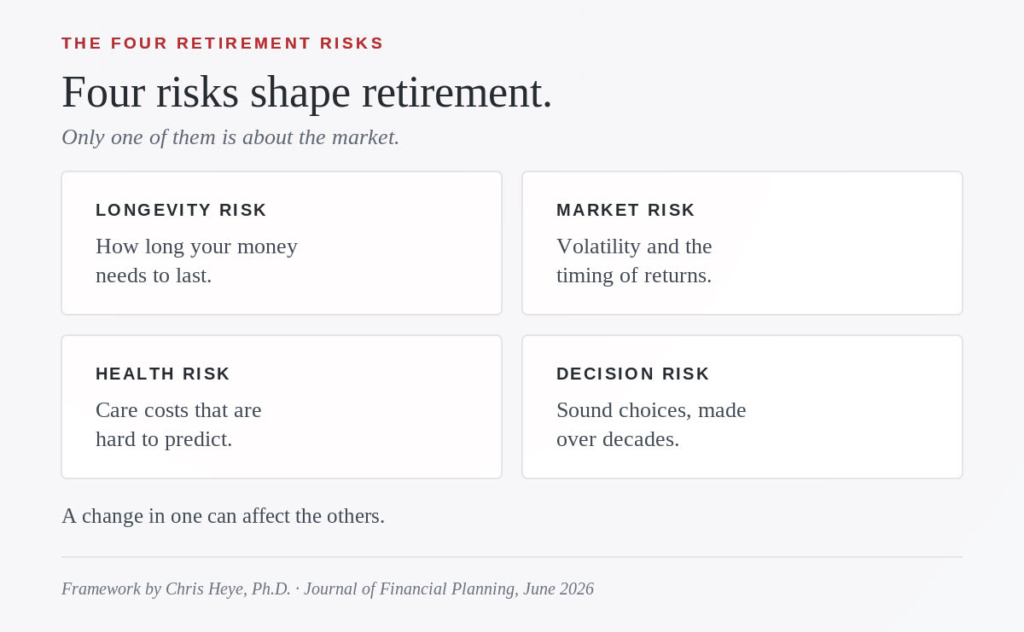
Chris Heye’s four-risk framework looks beyond investment performance. Each risk can influence the others throughout retirement.
Here’s what caught my attention.
We spend a lot of time talking about market risk, largely because it’s the one we can model. But retirement doesn’t happen in the market alone.
Your health can change your lifestyle, spending, and income needs, sometimes with little warning. In fact, more than 9 in 10 adults age 65 and older live with at least one chronic condition.2 Longevity adds another layer. A longer retirement could mean your savings and income strategy need to support you for decades.
Then there’s decision risk.
Retirement isn’t one big financial decision.
It’s a series of decisions you’ll make over many years — often arriving at the stage of life when they get harder to make. Estimates suggest roughly 14% of adults over 65 have dementia, with another 15% experiencing mild cognitive impairment. And households affected by cognitive decline may see their net worth decline by roughly 25% in the years before a diagnosis.1
Market declines are episodic. Cognitive change usually isn’t.
But here’s where this framework gets especially useful: These risks don’t exist in isolation. A change in one area can affect several others.
Imagine retiring with a healthy portfolio. A few years later, a health event increases your monthly expenses. You need to withdraw more from your portfolio, just as the market takes a downturn. And if your retirement lasts longer than expected, those larger withdrawals have more time to affect your finances.
One change. Several consequences.
That’s why looking at retirement through a wider lens can change the conversation. Your investments matter. So does preparing for unexpected expenses, adapting when life changes, and having someone in your corner to help you think through important decisions before they become urgent.
The four risks are connected. And your retirement planning should account for those connections.
Sources
- The Financial Planning Association, 2026 [URL: https://www.financialplanningassociation.org/learning/publications/journal/JUN26-beyond-sequence-returns-four-risks-retirement-security-OPEN]
- CDC, 2025 [URL: https://www.cdc.gov/pcd/issues/2025/24_0539.htm]


