
Mortgage rates affect much more than a homeowner’s monthly payment. They also influence home sales, home prices, consumer spending, and the broader economy.
For many households, a home is their largest asset, biggest monthly expense, and most significant source of debt. Housing also represents roughly 15% to 18% of U.S. economic activity.¹
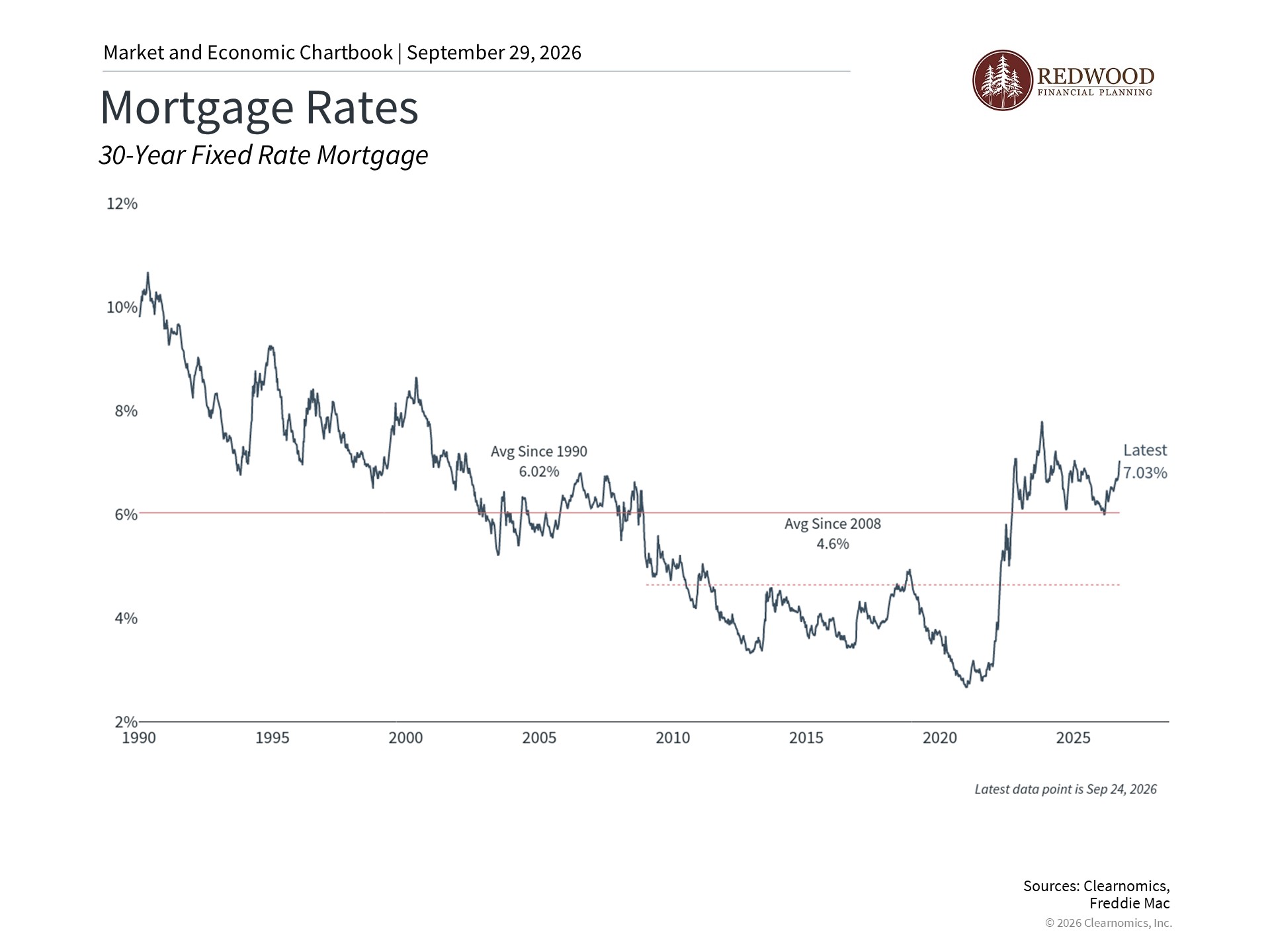
The average 30-year fixed mortgage rate is now above 7%, after falling closer to 6% earlier this year. Rates have been volatile, but they have not remained at this level for nearly 25 years. Here’s what that could mean for homeowners, buyers, and the economy.
Mortgage rates are back above 7%
Mortgage rates generally declined from the early 1980s through 2020, when rates reached historic lows during the pandemic.
From 1990 through the 2008 financial crisis, the average 30-year mortgage rate was about 6%. Since then, the average has been closer to 4.6%. During the pandemic, many homeowners obtained mortgages at rates of 3% or lower.
That makes today’s rates feel especially expensive by comparison.
The “lock-in” effect
Homeowners with very low mortgage rates may be reluctant to sell. Selling would mean giving up their current mortgage and taking out a new loan at a much higher rate.
This is known as the lock-in effect. It can reduce the number of existing homes available for sale and contribute to lower housing activity.
Policymakers have even discussed ideas such as “portable mortgages,” which could allow homeowners to transfer their existing mortgage rate to a new home.
According to the National Association of Realtors:
- Existing-home sales fell 2.0% from July to August.
- Sales were down 1.2% from the same month last year.
- Existing homes represented approximately 4.9 months of supply.
- New homes represented approximately 8.5 months of supply.
Higher inventory can be helpful for buyers. However, these figures are also influenced by the pace of sales. If homes remain on the market longer, inventory can appear higher even without a significant increase in new listings.² ³
Higher rates make buying more difficult
For people purchasing a home, higher mortgage rates usually mean higher monthly payments.
That can force buyers to make difficult choices, such as:
- Purchasing a less expensive home
- Choosing a different location
- Making a larger down payment
- Waiting for mortgage rates to decline
- Taking on a larger share of their income in housing costs
Some buyers may decide to wait. That can further reduce the number of homes being purchased and sold.
Home prices remain near record highs
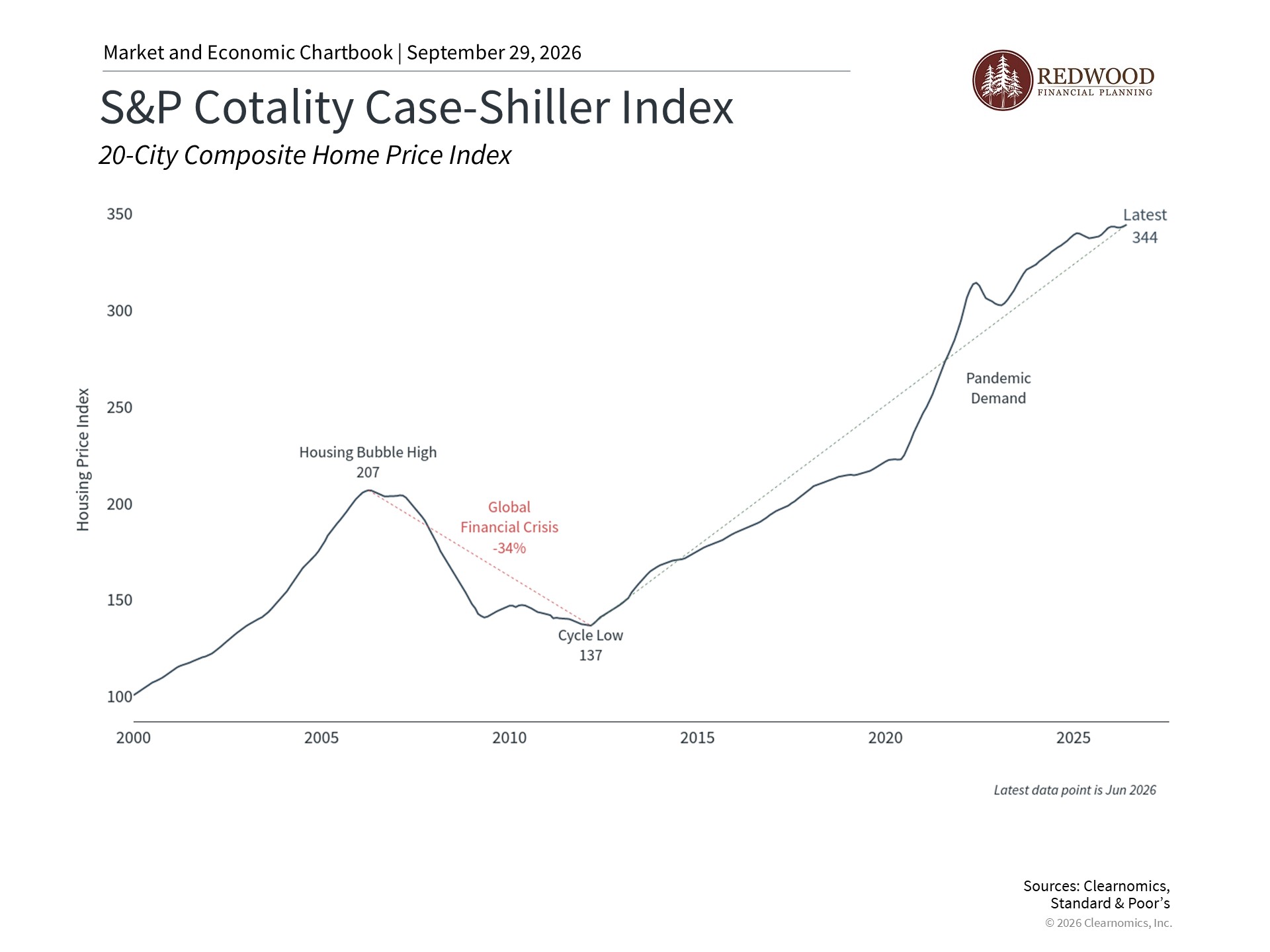
Even though home sales have slowed, national home prices remain close to record levels, according to the S&P Cotality Case-Shiller Index.
This may seem confusing, but prices and sales activity can move in different directions.
The economy remains relatively healthy, and unemployment is low. Many homeowners can afford to keep making their mortgage payments. At the same time, homeowners with low-rate mortgages may have little reason to sell.
That combination can create a market with:
- Fewer homes for sale
- Fewer transactions
- Continued price pressure
- Higher costs for new buyers
Home values can influence consumer spending
When people believe their homes are retaining or increasing in value, they may feel more financially secure. This is sometimes called the wealth effect.
The same can happen when stock market values are high. Households may feel more confident about their financial position and continue spending, even when consumer sentiment is weak.
This helps explain a recent economic puzzle: people have reported feeling pessimistic about the economy, but consumer spending has remained stronger than many economists expected.
One possible explanation is that sentiment is being affected by inflation and higher everyday costs, while spending is being supported by household wealth.
For example:
- Shelter costs have risen approximately 3% over the past year.
- Gasoline prices have risen approximately 27.4%.
- Housing costs make up more than one-third of the Consumer Price Index.⁵
Refinancing is much less attractive
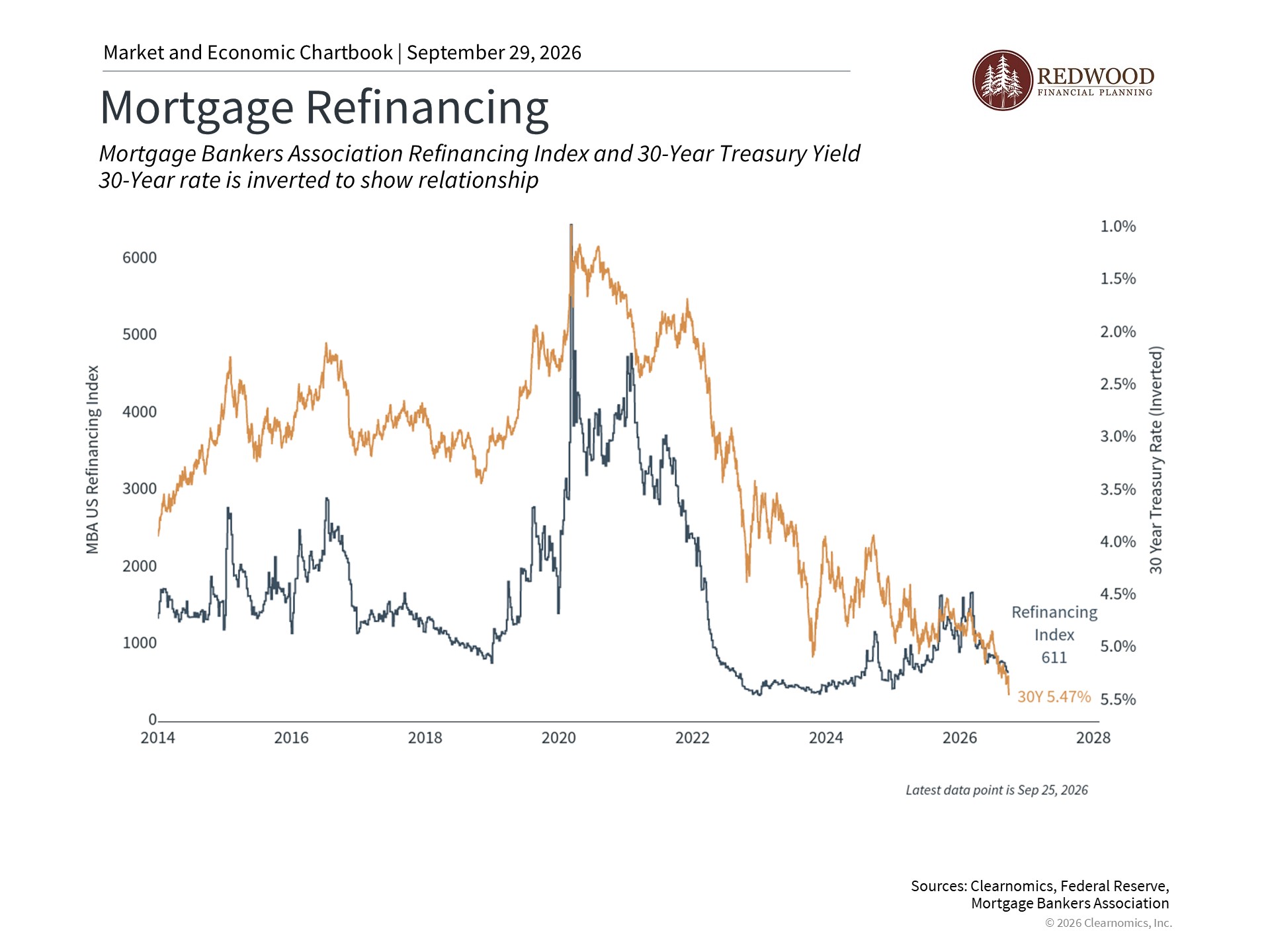
When mortgage rates were low between 2020 and 2022, many homeowners refinanced to reduce their payments or access home equity.
That opportunity has largely disappeared for homeowners with older, lower-rate mortgages. Refinancing activity has fallen sharply and is now near multi-year lows.⁶
This matters because refinancing can provide households with access to home equity. When refinancing becomes less attractive, homeowners may have fewer ways to turn rising home values into available cash.
That could eventually affect consumer spending.
Most households are still managing their debt
Mortgage debt remains the largest form of household borrowing. However, total household debt-service payments remain below their pre-2008 financial crisis peak.
Household debt service represented approximately 11% of disposable income in the second quarter of this year, compared with nearly 16% before the financial crisis.⁷
This suggests that most households are still managing their debt, even though higher rates have made borrowing more expensive and refinancing less appealing.
How long will rates remain elevated?
The future path of mortgage rates is difficult to predict. It depends on several factors, including:
- Inflation
- Energy prices
- Employment conditions
- Federal Reserve policy
- Treasury bond yields
- Overall economic growth
Several interest rates, including 5-year, 10-year, and 30-year Treasury yields, are near their highest levels in approximately two decades.⁸
Persistent inflation could keep interest rates elevated for longer. The Federal Reserve’s projections also suggest that policy rates may remain relatively high through at least 2027.⁹
The bottom line
Mortgage rates above 7% are creating challenges for both buyers and sellers.
Homeowners with low-rate mortgages may continue to stay put. Buyers may face higher monthly payments and fewer affordable options. Refinancing activity may remain limited, and home sales could stay sluggish.
At the same time, many households remain financially stable because they have manageable debt payments, substantial home equity, and mortgages obtained at historically low rates.
The most important response is not to react to every change in mortgage rates or housing headlines. Instead, households should review their broader financial plans, understand how housing costs affect their cash flow, and make decisions based on their own long-term goals.
Sources
- National Association of Home Builders
- National Association of Realtors, Existing Home Sales Report
- National Association of Realtors, Housing Statistics
- University of Michigan Surveys of Consumers
- U.S. Bureau of Labor Statistics, Consumer Price Index
- Mortgage Bankers Association and Clearnomics research
- Federal Reserve Economic Data and Clearnomics research
- U.S. Department of the Treasury, Interest Rate Statistics
- Federal Reserve, Summary of Economic Projections


